
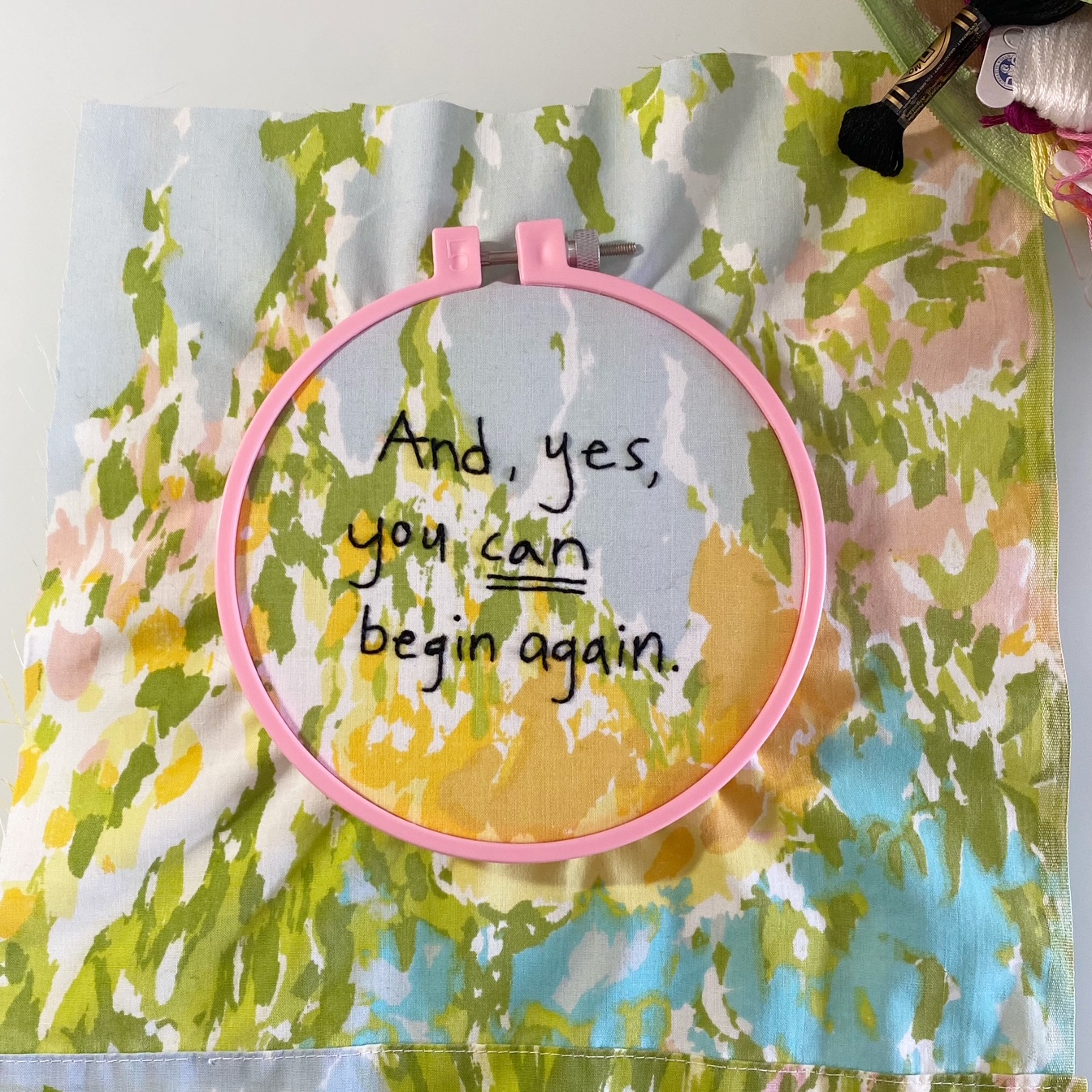
As crafters, we like patterns.
They can show us how to bridge the gap between our current skills and the skills we want others to learn, they can replicate what we see on someone else, they can allow us to craft items for our own bodies and homes in ever empowering ways.
In fact, I just finished a knitted scarf (which I’m wearing right now) from a pattern someone wrote. And some knitted socks from another pattern maker. I love patterns. They provide me with a way to select my own colors for a garment. They provide me with a way to financially support a maker. I get a thrill in finding just the right pattern that will suit my own body, shape and size.
However, I am always deeply pulled to projects and designs that are made without a pre-existing, or at least fully formed, map. Because this can push us further into making craft of our own design.
It also means stepping away, whether that’s forever, momentarily, or for a spell, from the cocoon, or perhaps even the safety net, that patterns can give us.
As for how to step away from a pattern? Well, that can feel like creatively sailing away on your own ship watching land get farther and farther away without a lighthouse in sight. And that fear, whether it’s something you’re keenly aware of or not, can come from not believing in, or perhaps not trusting, your own inherent creativity.

What is creativity?
It’s often thought in a binary sense, good or bad. Aesthetically pleasing, too ugly to put on the wall. You either have that innate talent or you don’t. It shows up in me when someone asks me to draw anything besides a stick figure. I panic and think back to all the things I’ve drawn that have been laughed at, that are never as good as the person’s beside me, that look like a child did them vs. me, a full-grown adult.
I feel sick at the thought of being asked to draw a dog that actually looks like a real dog. (In fact, I’m feeling queasy as I write about it.) And I was pretty happy when I aged out of such art class requests.
This fear of not making something good means that I’m not alone in this panic when I’m asked to play Pictionary. Or even when I’m drawing with small children in my life… although I’ve long ceded to the notion that their work will be better than mine. It’s why coloring books give me a sake of ease, someone else has drawn the cartoon mouse for me. I can relax.
That same sense of ease is something patterns bring. And it’s creatively wonderful because it makes us feel safe in the lines of the giant ears we don’t have to draw. We don’t have to get the paws just right, either.
Over time, we can take in the notion that we either are creative or we are not. Because creativity that appeases a cultural or perhaps community sense of aesthetic is purchased, praised, written about, liked, shared, lauded. Put on the fridge to look at every time you grab a snack. If it doesn’t, then, it’s into the waste bin or mocked or unliked or forgotten about. We’re told creativity is for children or perhaps art directors who look a certain way and have a better sense of taste. (Note: I have met many art directors who do not fit this mold!)
That’s not only damaging, it’s also kinda dumb. Who says only certain people can be creative? Who says creativity is only for kids? Who says creativity has to even be good to matter?
The people who say that? Almost always they fall into two camps: the people who have told themselves creativity isn’t serious business or the people who gatekeep creativity and keep it from being the pulsating, vibrant, portal that it is.
Removing the gatekeepers
As someone who spent years thinking that my creativity had to be accepted by certain people or done in a certain way, this discovery that that’s a cultural fallacy was relevatory.
And when you step out of that framework? You join a legacy of other people who also see creativity as a portal… all the other people who see creativity as a force of good and wonder and self discovery and experimentation and wide open expanse vs. a very narrow box that only some people fit within.
Because when the latter happens, our creativity can wax and wane depending on how others perceive it instead of how the act of creating makes us feel inside. This takes the power out of our own creativity. This takes us out of our own creativity. It removes our own voice from it in favor of someone else’s voice that is also approved by others.
And when it comes to craftivism, or sociopolitically engaged creative work, I want to see and hear your own voice. I may have written a definition of craftivism that some people still use decades ago, but I purposely kept it wide open because the power in such work for me is not being prescriptive or defining as to what it can be. (See also: I didn’t coin the term, only popularized it!)

The crux of it all
It is, quite simply, your skills, your personal history, your interests mashed together in a creative manner. My own formula of that is textiles + finding my own voice + helping others find theirs in different stitchy ways. Yours will be different, and that is why it is powerful to listen to, uncover, and let sink in.
In a world where everything feels polarized and overwhelming and frequently terrifying, your creative acts may be finding the right pattern. But it may also not be. I’m not here to tell you what’s right, only that if you’d like to make something to creatively share your own voice in your own way, you can do it.
But where to start? Here’s what I talk about in my workshops and talks:
- Think about a cause that you want to talk about. It could be something that you’re angry about or want to change or wish people talked about. It could be something that you need to hear yourself. Or that a loved one needs to hear.
- Think about what skills you either have or want to learn to share your voice. In what ways can you creatively show up? What ways make you feel good and expressive? It could be textiles, it could be baking. It could also be gardening. Or drawing. Or making a zine. It could be talking about your own history, your background, your unique experience.
- Next, think about how you can put those two things together. Maybe it’s baking for your community or stitching a slogan or knitting garments and donating the proceeds to a nonprofit you care about. Maybe it’s asking your friends to create panels for a quilt against war. Maybe it’s stitching feminist slogans. Maybe it’s something the world has seen before. Maybe it’s not. Maybe it’s bit of both. If your work is putting together something in public or for donation, make sure you have a plan to take it down once it becomes worn and is needed by the intended recipients, respectively.
- Experiment. Your feminist cakes may collapse in the oven. Your stitch project may not turn out at first how you want it to. You may have things you need to learn along the way. It may not look good, or as good as that thing made by that influencer you follow. It may not work as intended. That is normal. It just means you’re not there yet.
- Share what you’ve done. (If it feels good to do so.) Sometimes I have made projects just for me and only me. They were words I needed to hear for my own healing… a process which is usually not linear. Those pieces made me believe in my own voice because I stitched them into being. Sometimes, sharing means sharing what you’ve made with yourself. Sometimes that means only yourself. Other times, that means sharing it with other people, either a few or many.

Deconstructing the creative good/bad binary
This is a soft deconstruction of how we can make creativity our own. By taking steps that slowly empower us and our voices through skills and interests we already have.
To me, creativity is a superpower that connects us with our own shared humanity. It can make us scream and laugh and grieve and wonder and connect and question and grow.
To me, this happens when you decide that creativity will be a portal instead of a frivolous, silly thing that only unserious people do. Because, to me, creativity, and the discovery of it, in whatever medium you might enjoy, means taking back your voice as your own.
It means listening to what you alone want. It means creating projects that free other people to start feeling the same. And that feeling of being on a ship floating away from land? Becomes a welcoming sign that you’re on your way to charting your own creative course. Maybe that’s a craftivist project, maybe it’s not.
But by embracing that your own creative voice has power, and that you have your own agency within that exploration, you become more of who you were meant to be in the doing. Your making without a map means you are building self trust in your own creative voice. And you can build your own dang map in the process.
That means that each stitch you create, each thing you make? It, in turn, makes you. You become the lighthouse.
P.S. If you want more on starting your first (or perhaps next!) craftivist or creative project, click this link.